



Latin America: A Key Player in the Global Energy Transition
"Latin America is advancing in the energy transition with high renewable potential and key resources, although investment and grid challenges persist."


América Latina y el Caribe concentran el 8% de la población mundial y el 7% de la economía global. Desde Latin America and the Caribbean account for 8% of the world's population and 7% of the global economy. Since 1971, the region has contributed only 5% of global energy-related greenhouse gas (GHG) emissions, while during the same period, it contributed 9% of the global GDP (IEA, 2023). These figures reflect an advantage: producing more with fewer emissions.
While nearly 80% of the world's energy supply comes from fossil fuels, in Latin America, that proportion drops to 68%, thanks to approximately 60% of regional electricity being generated from renewables, especially hydroelectric power (IEA, 2023). This difference positions the region as one of the natural leaders of the energy transition.
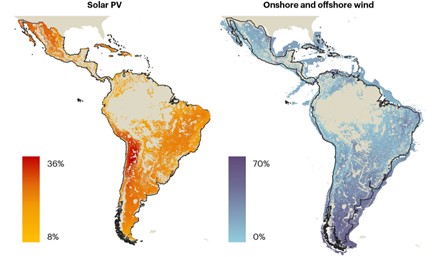
The region boasts unique advantages: the Lithium Triangle (Argentina, Bolivia, and Chile) concentrates 60% of global reserves; Chile and Peru are global benchmarks for copper, an essential mineral for electrification; and the deserts of northern Chile, Argentine Patagonia, or the Brazilian Northeast offer some of the planet's best solar and wind resources. Added to this is the accumulated experience in hydroelectric and bioenergy, which transforms Latin America into a living laboratory for clean energy.
Solar PV and wind average capacity factors in Latin America and the Caribbean, 2022
Source: Latin American Energy Outlook 2023.
Challenges: Regulation, Investment, and Digitalization
The path, however, is full of challenges. The region still depends on fossil fuels in sectors such as transport and industry, and losses in transmission and distribution account for between $9.6 billion and $16.6 billion per year. This economic and environmental burden compromises the financial viability of distribution companies and generates distrust among users (IDB, 2024).
Furthermore, investment in clean energy must double: the IEA estimates that Latin America needs to mobilize $150 billion annually compared to the current figure of approximately $75 billion (IEA, 2023). Achieving this requires regulatory stability, innovative financing schemes, international cooperation, and a legal framework that provides long-term predictability.
The digitalization of electricity grids is unavoidable. Initiatives like Copel's smart meters in Brazil (1 million installed), electromobility in Santiago and Bogotá—with the largest electric bus fleets in the region—or the national charging network in Costa Rica, which is 98% backed by renewable energy, show that the transition is no longer just a concept but a reality in progress.
Cooperation and Regional Examples
Progress cannot be isolated. The region needs greater electrical integration and regional cooperation to take advantage of complementarities between countries: solar energy from the Atacama Desert, Amazonian hydroelectric power, Patagonian wind. Coordination will allow for diversifying risks, balancing generation, and moving toward an interconnected and resilient Latin American grid.
Positive examples already exist:
Costa Rica operates with over 98% renewable electricity, although it faces the challenge of droughts and hydroelectric variability (El País, 2024).
Brazil reached 88% renewable electricity in 2024, combining hydroelectric, solar, and wind (Review Energy, 2024).
Chile went from 56% clean electricity in 2022 to nearly 70% in 2024, with solar already contributing over 23% (InvestChile, 2024).
Colombia maintains a renewable matrix of 75–83% but is advancing in diversification with solar and wind (Energía Coop, 2024).
Argentina: installed capacity was 58% thermal, 38% renewable, and 4% nuclear (Annual Report 2024, CAMMESA).
Uruguay: record renewable generation, registering days of 100% renewable consumption.
A Future That Demands Decisions
Latin America has the opportunity to be a protagonist in the global energy transition. To achieve this, it must modernize its regulation, digitalize distribution grids, ensure stable financing, and deepen regional cooperation.
The region's energy future depends not only on what is generated but on how it is managed, distributed, and leveraged. By accelerating the pace, Latin America can stop being a promise and consolidate itself as a global engine for the transition toward a low-carbon future.
North Delegation
Federico Rossi 600 - Yerba Buena, Tucumán, Argentina
+54 9 11 6422-0088
info@smartenergysolutions.com.ar
Subscribe for the latest news
South Delegation
Los Pinos 1758 - Cipoletti, Río Negro Argentina
+54 9 11 6438-8507
info@smartenergysolutions.com.ar